Sharik’s transplanted pituitary gland
The Heart of a DogSharik’s transplanted pituitary gland is the crucial human component of Professor Preobrazhensky’s experiment: taken from Klim Chugunkin and placed in Sharik, it redirects an operation associated with rejuvenation toward the creation of a human being. The professor eventually identifies the gland not as a means of restoring youth but as a force that shapes individual human identity, a discovery he regards as scientifically momentous even after it overturns his expectations.
Origin and Implantation
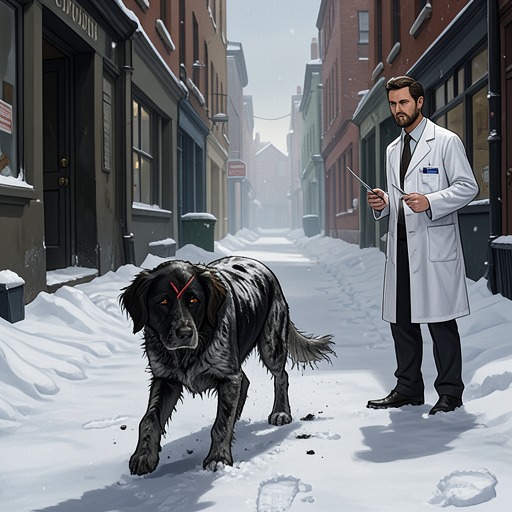
The gland came from the same deceased 28-year-old man whose testes were used in the operation. On December 23, the professor began the procedure at 8:05 p.m.; the donor had been dead for four hours and four minutes, and his organs had been kept in sterilised physiological fluid. The account records the testicular transplant first, then notes that the professor removed Sharik’s pituitary and replaced it with the human gland. Chloroform was among the drugs used.
The operation’s close physical procedure is presented through the hands of the surgeon and the instruments of the theatre. Bormenthal passed the professor a beaker containing a white mass suspended in fluid. The professor removed Sharik’s gland and set it aside, inserted the replacement with thread, and secured it before returning the brain to its bony container. In the operation’s sequence, the human gland is not an incidental addition: it is deliberately substituted for the dog’s own pituitary, making the transplant the experiment’s central intervention.
From Rejuvenation to Humanisation
The experiment’s meaning changed as its consequences became apparent. In an entry dated January 8, the record states that the professor had finally accepted his error: pituitary transplantation caused total humanisation, not rejuvenation. That correction overturns the initial purpose without diminishing, in his assessment, the value of the discovery. The gland’s significance thus lies partly in the distance between the result sought and the transformation produced.
Four days later, Bormenthal’s notes describe a new interpretation of the pituitary’s function. He connects it to the formation of human appearance and calls its hormones the hormones of a person’s image. His account casts the experiment as the creation of a new human entity by surgery rather than by the imagined apparatus of alchemy. This is Bormenthal’s interpretation of what the operation has revealed; it registers his sense that the gland has opened a new scientific field, not proof that the transformation can be directed or controlled at will.
Chugunkin and the Individual Image
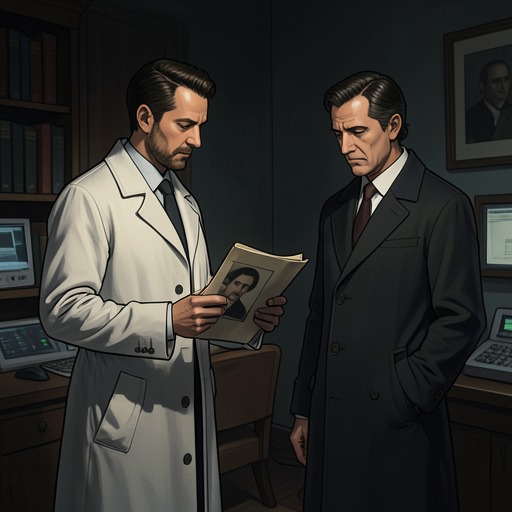
The donor’s identity becomes essential to understanding what the transplanted gland brings into the experiment. The professor names Klim Chugunkin and recalls his two convictions, alcoholism, and the phrase associated with taking property and dividing it. He also connects Chugunkin to the loss of his beaver hat and twenty roubles, and remembers his presentation walking-stick as another item taken. The donor is therefore not an abstract source of tissue in the professor’s explanation: the human material carries an individual history that the experiment cannot simply reduce to a neutral biological component.
The professor describes the pituitary as a kind of magic box that determines an individual human image, then draws a limit around that claim. It shapes the particular person, he argues, but does not produce a universal human image. The distinction complicates the idea that the gland acts as a simple blueprint: in the professor’s account, the outcome is tied to the donor’s individuality rather than to an ideal, interchangeable form.
Scientific Significance and Limits
The gland changes the professor’s account of his own project. He says that he had been concerned with eugenics and the improvement of the human race but had ended up specialising in rejuvenation; the experiment now presents him with a discovery about human formation instead. His reaction holds pride in the scientific result alongside frustration at the direction the work has taken. The organ is at once evidence of the experiment’s reach and a reminder that the result has not followed the purpose that prompted it.
Within the story, the pituitary is therefore both a material transplant and the hinge of a conceptual reversal. Its removal from Sharik and replacement with a human gland make a humanising transformation possible; the professor’s later explanation assigns it a role in determining individual identity, while Chugunkin’s history makes clear that the resulting human image is bound to a specific donor. The episode presents scientific creation not as the execution of a fully mastered design, but as an intervention whose consequences force its practitioners to revise what they believe they have made.